
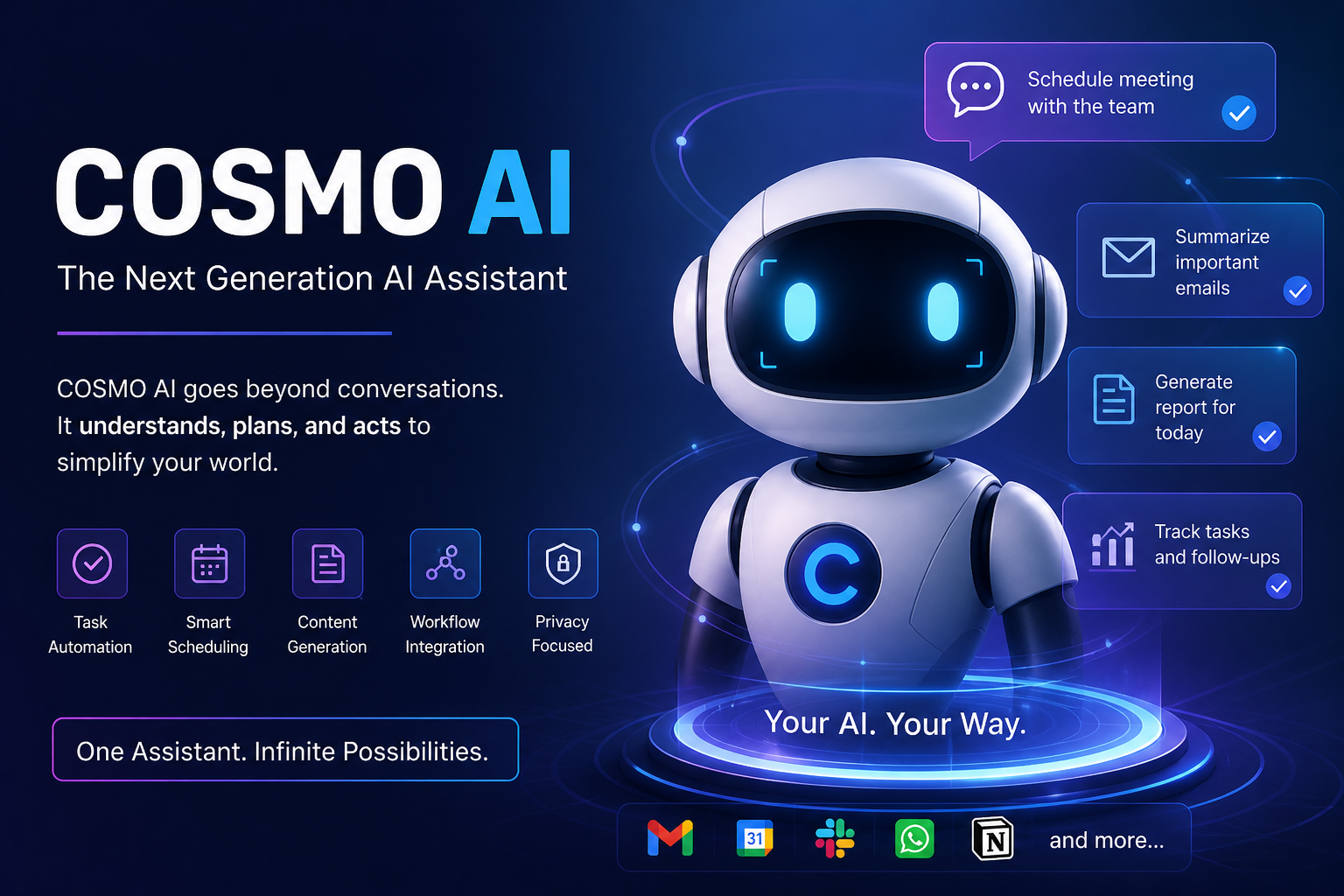
COSMO AI: The Shift from Assistants to Autonomous Digital Operators
COSMO AI: The Future of Intelligent Digital Assistants is Here
The way we interact with technology is changing faster than ever. For years, software has required us to click, type, and manually manage tasks. Then came AI assistants that could answer questions and generate content.
Now, we are entering the next phase — where AI doesn’t just assist, but acts on our behalf.
One of the latest developments pointing in this direction is COSMO AI, an emerging concept in the AI space that signals a major shift in how digital assistants will work in the near future.
Beyond Chatbots: A New Kind of AI
Most people are familiar with AI tools that respond to prompts — you ask, and they answer. While powerful, these tools still rely heavily on human input to move forward.
COSMO AI represents something different. It is designed to move beyond conversation and into execution. Instead of simply suggesting what to do, it can take action — whether that’s organizing your schedule, drafting communications, or managing routine workflows.
This evolution transforms AI from a passive tool into an active digital operator.
Designed for Real Work, Not Just Conversations
What makes COSMO AI stand out is its focus on real-world usability. It’s not built just for writing or answering questions — it’s built to handle everyday tasks that professionals deal with.
Imagine starting your day and asking your AI to prepare a summary of your meetings, respond to key emails, and schedule follow-ups — all without switching between apps.
That’s the kind of experience COSMO AI is moving toward.
Instead of juggling multiple tools, users interact with a single intelligent system that understands context and handles execution.
The Rise of On-Device Intelligence
Another important shift behind COSMO AI is the move toward on-device AI. Traditionally, most AI systems rely heavily on cloud processing. While effective, this approach can raise concerns around speed, connectivity, and privacy.
COSMO AI explores a hybrid approach, where part of the intelligence runs directly on your device. This enables faster responses and better control over personal data.
In a world where users are becoming increasingly conscious about privacy, this direction is not just innovative — it’s necessary.
A Smarter Way to Work
At its core, COSMO AI is about simplifying complexity. Modern workflows are often fragmented across tools, platforms, and communication channels. This creates inefficiencies that cost both time and productivity.
By integrating context awareness with automation, COSMO AI aims to reduce this friction. It understands what you’re trying to achieve and helps execute it with minimal effort.
This is especially powerful for businesses, where repetitive tasks consume a significant portion of daily operations. With systems like COSMO AI, teams can shift their focus from routine work to more strategic thinking.
The Challenges Ahead
As promising as COSMO AI is, it also brings important challenges. Giving AI access to systems, data, and decision-making processes requires a high level of trust.
Questions around data security, accuracy, and over-reliance on automation are still being explored. Like any evolving technology, it will take time for these systems to mature and become widely adopted.
Businesses and individuals will need to balance convenience with control as they integrate such tools into their workflows.
What This Means for the Future
COSMO AI is not just a product or a feature — it’s a glimpse into the future of human-computer interaction.
We are moving toward a world where:
• Software becomes invisible
• Tasks are handled automatically
• Users focus on outcomes, not processes
In this new model, AI becomes less of a tool and more of a partner in productivity.
Final Thoughts
The shift from “doing tasks manually” to “delegating tasks to AI” is one of the biggest transformations happening in technology today.
COSMO AI sits right at the center of this change. While still evolving, it represents a future where technology adapts to humans — not the other way around.
And the real question is no longer if this change will happen…
It’s how fast you’re ready to adapt to it.
Are you ready to move from using software to managing intelligent systems?